This month Zara Jones, our new Chief Executive, took up her post at the Trust. Zara has been talking to us about her career, her reflections on the NHS and what’s changed in the last 23 years, and what challenges it faces today, and in the years to come. And Zippy the spaniel makes a special guest appearance.

How did you get started in the NHS?
I joined the NHS as a graduate management trainee in 2003, although that definitely wasn’t the original plan.
I’d always wanted to work in healthcare and had a place at university to study physiotherapy. Unfortunately, my A-level results had other ideas and I lost the place. At the time that felt pretty disastrous, but I went on to study a broader health-related degree and, shortly before graduating, applied for the NHS Graduate Management Training Scheme.
I’m a big believer that careers don’t always follow the route you expect them to. Something that felt like a fairly significant setback at age 18 ultimately led me to a career I’ve loved and probably wouldn’t otherwise have had.
Did you imagine back then that you would be in the top job, as Chief Executive of an NHS Hospital Trust?
I remember, as a trainee, reading about people who had been through the same scheme and gone on to become Directors and Chief Executives. They seemed a very long way removed from where I was at the time, and I didn’t really imagine that I would ever be one of them.
I’ve never had a career plan that said, ‘I want to be a Chief Executive within X number of years.’ I’ve tended to focus much more on doing a job I find interesting, learning from it and then being prepared to take the next opportunity when it comes along.
So there is something slightly surreal about starting at East Cheshire as CEO 23 years after joining the NHS as a management trainee.
Where did your career take you after that first job?
I deliberately tried to get a real breadth of experience. I spent the next few years working in different NHS organisations, mainly across the Midlands and South Yorkshire, which kept me reasonably close to home.
I’ve worked in hospitals, commissioning organisations and regional roles and have now spent around ten years as an Executive Director. Most recently I was Deputy Chief Executive and then Acting Chief Executive at Doncaster and Bassetlaw Teaching Hospitals.
That breadth has been really useful. You see the NHS quite differently depending on where you sit. Working in a hospital gives you one perspective, working in commissioning gives you another and working regionally gives you another again.
One of the things I’ve learned is that very few of the problems we face fit neatly within the boundaries of one organisation. Patients certainly don’t experience healthcare in organisational boxes, even if we sometimes design it that way.
What’s changed in the NHS in the intervening years?
A huge amount has changed in 23 years.
Technology is probably the most obvious. When I started, paper records, fax machines and physical files were still a normal part of everyday NHS life. We now have electronic patient records, virtual appointments, remote monitoring, robotics, genomics and increasingly artificial intelligence. Some of what is possible clinically today would have seemed extraordinary when I joined.
Patients rightly expect something different too. People have much greater access to information and expect to be involved in decisions about their own care. We talk much more about treating the person rather than simply treating a condition and about the experience of patients and families alongside the clinical outcome.
We also talk much more openly about things we perhaps didn’t talk about enough 20 years ago — patient safety, inequalities, inclusion, speaking up and the experience people have at work. That doesn’t mean we’ve solved those things, but there is a much greater expectation that we listen, learn and act.
The NHS has also become much more complex. We’ve reorganised ourselves numerous times and created lots of structures, processes and rules, usually for perfectly sensible reasons. But the cumulative effect can sometimes be that we make relatively simple things surprisingly difficult.
And the population we’re caring for has changed. People are living longer and often living for many years with multiple conditions. That’s a great achievement in many ways, but it means the model of healthcare we need has to change too.
What hasn’t changed is the fundamental reason people come to work in the NHS. Wherever I’ve worked, I’ve met people who care deeply about doing the right thing for patients and their communities. After 23 years, that’s still the bit I find most powerful.
What sort of challenges do you think the NHS is facing today and in the next five years?
There are some very immediate challenges: people waiting too long for care, pressure on urgent and emergency services, financial pressures and a workforce that has been through an incredibly demanding few years.
But I think the bigger challenge is whether we can genuinely change the way we provide care rather than simply trying to work harder at the model we’ve already got.
This is personal for lots of families, including mine. My grandmother celebrated her 97th birthday a few weeks ago and she has Alzheimer’s. I’ve been no stranger to hospital visits with her over the years and recently I spent time with her in another hospital where she experienced corridor care and a very long wait of around 20 hours within the Emergency Department.
When you’re sitting there with somebody you love who has dementia, who is confused by what’s happening around them and has needs that go well beyond the particular medical problem that brought them to hospital, some of the big debates about the future of health and care become very real.
It’s also a reminder that the answer isn’t simple. We need to get much better at helping people remain independent and well at home, joining up health and social care and making sure that when somebody does need hospital care, we get them to the right place quickly and help them get home again as soon as it is safe to do so.
That’s why I think the renewed national conversation about social care is so important.
The Prime Minister has recently set out plans for a National Care Service and talked about health and social care as one interconnected system rather than separate problems. Whatever the eventual model looks like, I think we have to confront that question. We have talked about integrating health and social care for most of my NHS career and the experience of people like my grandmother shows why we need to turn that ambition into something people actually experience.
Technology will be another enormous part of the next five years. I’m excited by what it can do, including AI, but technology isn’t an end in itself. The test has to be whether it gives patients better care, makes life easier rather than harder for colleagues and frees people up to spend more time doing the things that only humans can do.
What do you like best about the NHS?
The people and the sense of purpose.
There aren’t many jobs where, whatever your role, you can draw a fairly direct line between what you do and making a difference to somebody’s life.
I also love the sheer variety of people who make the NHS work. We understandably think first about doctors and nurses, but a hospital couldn’t function without healthcare assistants, therapists, scientists, pharmacists, porters, cleaners, receptionists, engineers, catering teams, administrators and hundreds of other roles.
And people do extraordinary things every day without regarding them as extraordinary. I don’t think we should ever become so accustomed to that that we stop noticing it.
What do you like least about it?
Probably our ability to make things more complicated than they need to be.
We can spend an enormous amount of time in meetings, writing papers, creating processes and discussing who is responsible for something when sometimes we just need to get the right people together and sort it out.
I also get frustrated when we know something isn’t working but somehow learn to live with it. There are always good reasons why change is difficult, particularly in healthcare, but ‘that’s how we’ve always done it’ isn’t a good enough reason not to make something better.
And I think kindness and accountability sometimes get presented as though you have to choose between them. I don’t think you do. We should be kind and compassionate with each other and we should also be clear about what patients and colleagues have a right to expect from us and each other.
What about outside work, do you have any hobbies, interests, pets?
Running takes up a fair amount of my spare time, although I’m never entirely sure I’d describe myself as somebody who actually enjoys running!
It started when my husband and I decided to run a marathon to raise money for charity. We completed that one, somehow got the bug and have since done quite a few marathons together and moved on to longer-distance events.
For me, it’s less about the running itself and more about deliberately doing something that’s uncomfortable, not knowing for certain whether I can do it and then seeing what I’m capable of. I’m not particularly interested in running fast — for me it is much more about seeing whether I can finish.
That doesn’t always go entirely to plan. Earlier this year we attempted a 70-mile event called The Wall and made it to 51 miles before some pretty horrendous blisters finally defeated me. We’ve already entered again for next year, so apparently, I don’t learn from experience.
We also have two teenage children, so between family life, work and running there isn’t usually a great deal of spare time left!
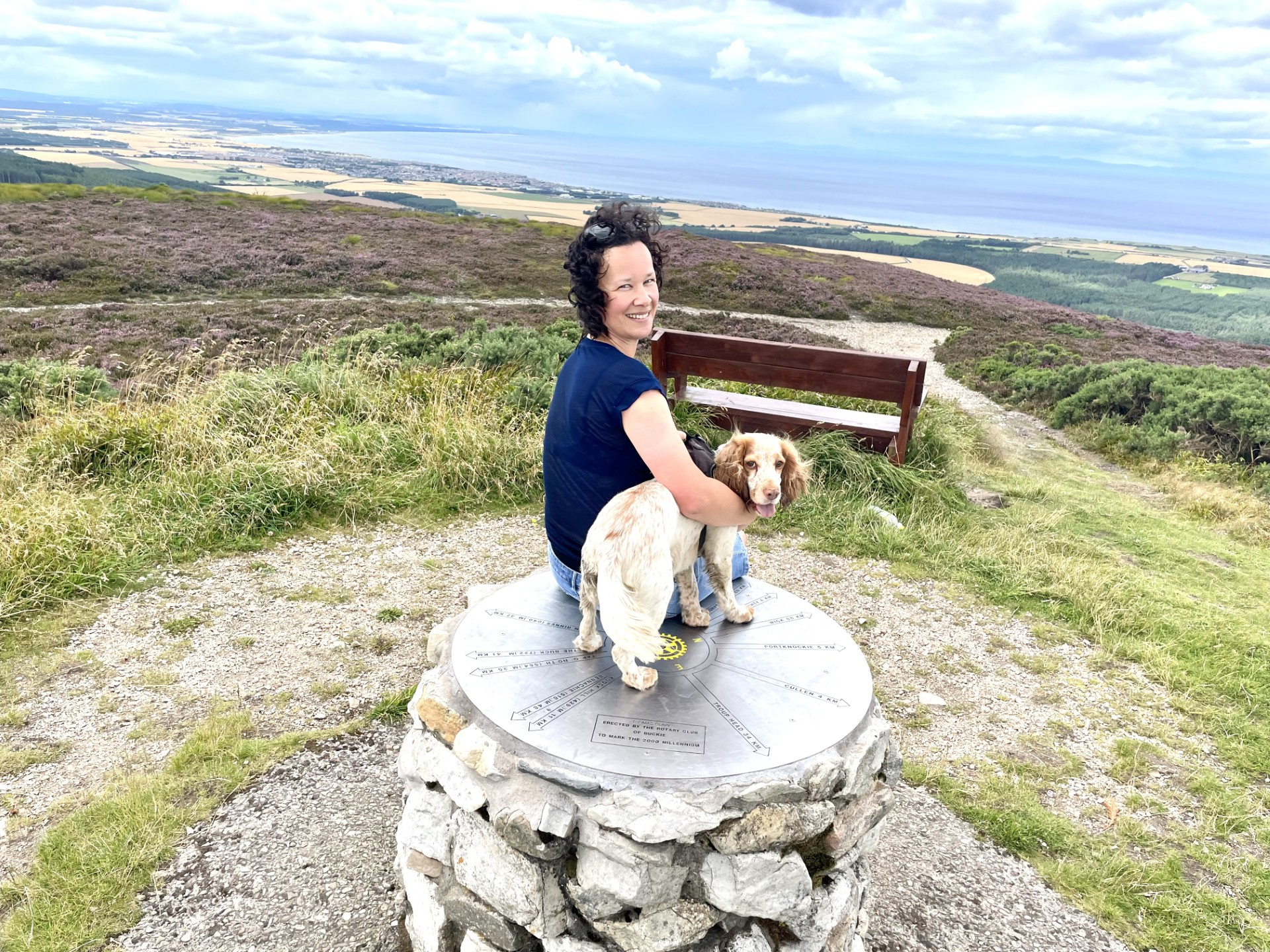
And then there is Zippy, our spaniel, who is likely to be considerably more popular than me if he makes an appearance. He’s appropriately named and remains completely unimpressed by anything I achieve at work, unless it somehow results in food or a walk.
Found a problem? Report it and help us to improve our website